
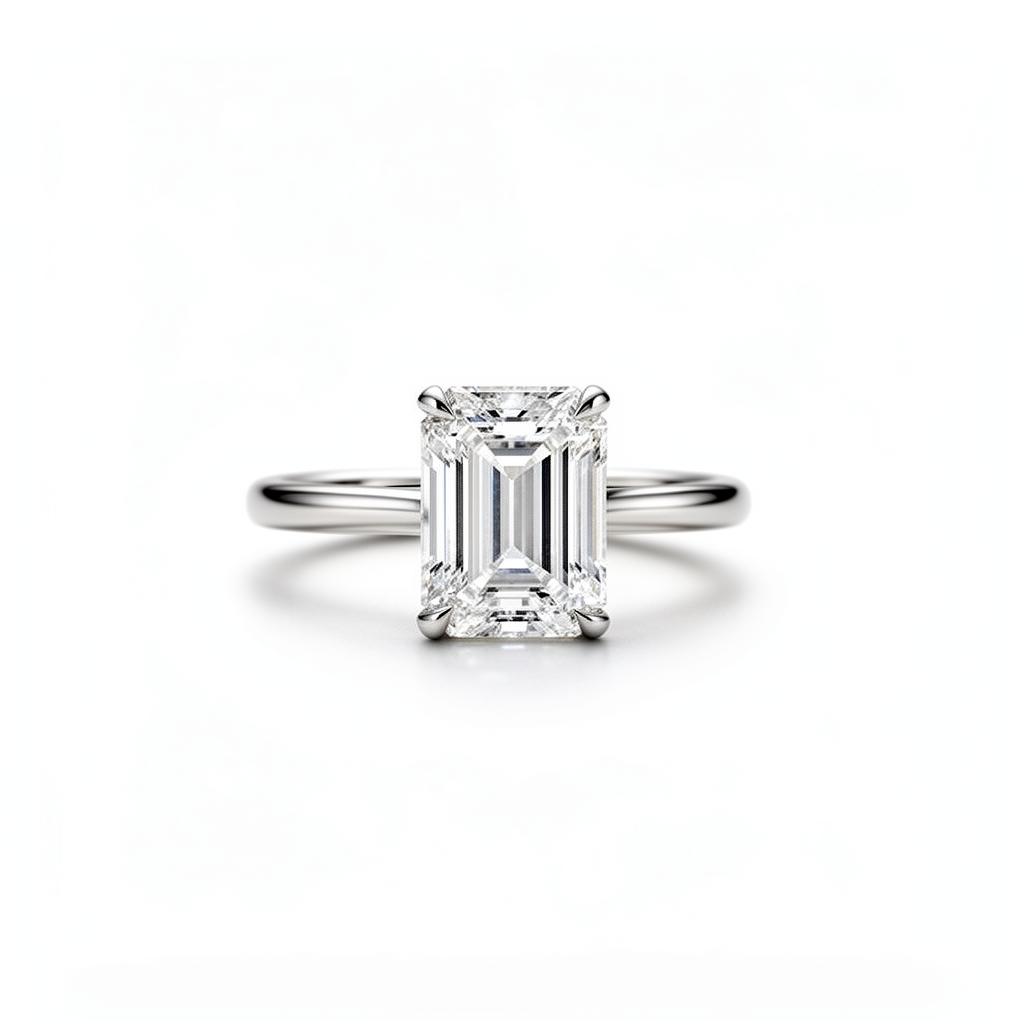
A client recently asked me, with the genuine curiosity of someone who has spent a career around extraordinary things, why we still weigh wedding bands in grams. Carats, she said, are the language of jewelry. Grams belong on a kitchen scale. She was teasing, but the question was a real one, and it deserves a real answer.
The honest reply is that a wedding band is not, in the strict sense, jewelry. It is closer to architecture. A diamond solitaire is a soloist; a band is a load-bearing wall. It has to live on a hand for fifty years — through dishwater, gardening gloves, the steering wheel of a car driven up the coast and back, the small unromantic frictions of a long life — and emerge at the end of all of that still recognizably itself. Carats cannot do this work. Grams can.
I. The arithmetic of permanence
A 950 platinum band of five and a half millimeters, struck in the half-round profile we use in our Beverly Hills workshop, weighs between five and seven grams depending on the finger. That figure is not arbitrary. Below five grams the band begins to flex; the engraving inside distorts over a decade of wear. Above seven, it announces itself. It taps against glassware. It catches on cashmere. It stops being an object you forget and becomes an object you manage.
Six grams, give or take, is the threshold at which a wedding band disappears into the hand of the person wearing it and reappears only in moments of attention — when light catches the polished edge, when a thumb finds the inner curve out of habit, when it is removed at night and set on the nightstand with that soft, unmistakable sound of dense metal meeting wood. That sound is the point.
II. Density is a kind of intimacy
Platinum is roughly sixty percent denser than 18-karat gold. A band that looks identical in two metals will feel entirely different on the finger — and, more importantly, in the small private gesture of turning it absent-mindedly during a difficult phone call. The heavier metal answers the gesture. The lighter one does not. This is not romance. It is physics. But the two are not as far apart as we like to pretend.
We sometimes describe our bands as "quiet." What we mean is that their authority is held in the wrist rather than in the eye. A stranger across a room will not notice a Hanseletti band. The person wearing it, however, will be aware of it constantly, in the way one is aware of a wedding ring — which is to say, not at all, and entirely.
III. Against the carat
None of this is an argument against stones. A stone, set well, in the right hand, on the right occasion, is one of the great human inventions. But a stone is an event. A band is a condition. The distinction matters because the two objects answer different questions, and a great deal of contemporary jewelry has confused them — loading bands with pavé until they become small parties on the finger, brilliant and exhausting.
A wedding band is the only piece of jewelry most people will ever wear without removing. It will outlive the rest of their collection. It will, with luck, outlive them. Six grams of platinum, struck in MMXXVI, engraved with a number that means nothing to anyone but its wearer, is a small and serious answer to a small and serious question: what survives?
Six carats will be admired. Six grams will be there.